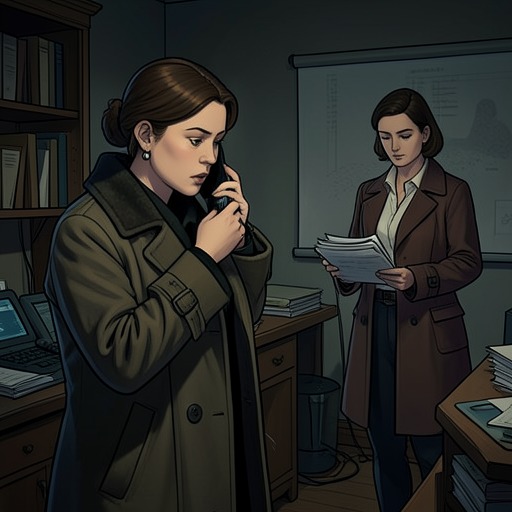
Ravn Threatens Smilla to Stop Her Investigation
Smilla's Sense of SnowRavn’s threat to Smilla is a calculated exercise of state power that brings her investigation into Isaiah’s death to a halt. In a bare police office, he uses the records of her life, her history of confidential Arctic work, and the prospect of solitary confinement to make the warning credible. The encounter turns on a grim contrast: the open spaces of Greenland that shaped Smilla’s need for freedom, and the locked room with which Copenhagen can threaten her.
The encounter at Police Headquarters
After a funeral, Ravn approaches Smilla with two large men in blue suits and sunglasses, addressing her as “Miss Jaspersen.” He takes her to Police Headquarters, where they leave the red-brick offices of the Division of Motor Vehicles for a low, unmarked barracks facing the harbor. The building offers none of the familiar signs of a busy police station: no nameplates, no typewriters, no people in the corridors. Its quiet recalls a reading room or the morgue beneath the Institute of Forensic Medicine.
In a dark office overlooking the docks, the water, and Iceland Wharf, Ravn switches on the light to reveal Captain Telling waiting in a chair. A woman briefly brings tea on a white porcelain tray, then disappears into the otherwise deserted building. The tea remains untouched and grows cold. These spare details make the meeting feel less like an ordinary interview than a demonstration arranged for Smilla: the institution is quiet, controlled, and able to produce people and information without explanation.
The dossier as an instrument of pressure
Ravn opens a pink folder and reads aloud a concise account of Smilla’s education, scientific training, and expedition work. It records her birth in Qaanaaq, schooling in Greenland and Copenhagen, courses in glacial morphology, statistics, and mathematics, and later employment at the Geodetic Institute. It also lists her Arctic expeditions and her work planning Danish and French journeys to North Greenland. The file even preserves a military reference complaining that she would not drive a dog team; asked whether she is afraid of dogs, Smilla answers that she is merely cautious.
A second, dark-green folder shifts the emphasis from qualifications to vulnerability. It contains private and political history: her mother Ane Qaavigaaq’s disappearance while hunting, her brother’s suicide in Upernavik, the transfer of her custody to her father, repeated reports that she had gone missing, and her expulsions from schools. It also records that she left the University of Copenhagen without a degree and was arrested during the Council of Young Greenlanders’ occupation of the Ministry of the Environment, before becoming active in the founding of Inuit Ataqatigiit after the council split.
Ravn presents these facts as a portrait of someone unfinished, isolated, conflict-prone, and politically suspect. Smilla does not answer his characterization; instead, she privately adds him to her mental “black book.” His dossier is not simply a collection of background information. Its juxtaposition of her unsettled personal record with her repeated service on Arctic expeditions shows how the state can treat the same person as unreliable in one setting and useful in another.
Confidential work and the warning
Ravn’s central concern is Smilla’s interference in the investigation of Isaiah’s death. He invokes her nine expeditions in twelve years, on which she served as navigator and worked with confidential maps, satellite and radar photographs, and military meteorological observations. Each time, she signed a secrecy declaration; the authorities, he says, have copies. Her access to the Arctic has given her knowledge, but it has also made her legible to institutions that monitor and retain information about her.
He casts her as a sensitive issue in a small country: someone who has seen and heard much in North Greenland, yet whose past and character would have prevented her from being granted the same access elsewhere in Danish territory. His advice that she keep a low profile quickly becomes an explicit accusation. He objects to what he calls her fruitless or damaging attempts to meddle in the case, despite having previously promised to look into it. Smilla reminds him that he made that promise while still working for the Copenhagen district attorney.
Ravn then turns from admonition to threat. He says the authorities can imprison her at any time, including in solitary confinement or an isolation tank, and claims that no judge would hesitate after seeing her dossier. The force of the threat lies not only in the punishment he names but in the demonstration that precedes it: he can obtain information she sent to Greenland’s government and the military, follow her movements, reach into archives, and summon an intelligence officer at Christmas. The meeting establishes his capacity to act, rather than merely his willingness to intimidate.
The locked room and the end of the investigation
Ravn’s most pointed warning is that imprisonment in a small, windowless, soundproof room is especially uncomfortable for someone raised in Greenland. Smilla recognizes the precision of the threat. In her account, Greenland has no prisons, and offenses that would bring imprisonment in Denmark are more often punished by fines there. She contrasts the European image of hell as a rocky landscape with sulfur pools with what she calls the Greenlandic hell: the locked room.
That contrast connects the immediate threat to Smilla’s remembered childhood. Her mother could not imagine remaining in one place for long, and Smilla understands spatial freedom as something she protects with almost sacred intensity. Ravn has found a way to threaten not merely her liberty in the abstract but the condition she most fears losing: the ability to move through open space. His measured manner makes the threat more chilling; the narration finds no sadism in him, only a precise understanding of the instruments at his disposal.
The encounter ends without resolution or even the comfort of a completed conversation. Smilla and Ravn stand, leaving their tea untouched and cold. She concludes that she has reached the end of the road in her investigation of Isaiah’s death. The warning therefore succeeds, at least for the moment: the investigation stops not because the evidence has been exhausted, but because Ravn has made the consequences of continuing unmistakable.
Narrative significance
The confrontation makes information itself a form of coercion. Ravn does not need to conceal Smilla’s past; he reads it back to her, rearranging experiences that belong to her into an official account that can be used to discredit and confine her. The files turn biography into leverage, while the references to confidential maps and military observations expose the institutional price of her Arctic expertise.
The scene’s central opposition is between mobility and confinement. Smilla’s work has repeatedly taken her across ice and into remote northern territories; Ravn answers that history with the image of a sealed room. The threat gains its force from the difference between the two legal and lived worlds she carries within her: Greenland as remembered open space, and Danish authority as the power to lock her away. Her declaration that the investigation has reached its limit marks a real consequence, but the untouched tea and the unresolved death leave the encounter feeling like enforced suspension rather than a genuine conclusion.